
Muncie City Directory Holdings
Muncie's historical shelf is unusually strong. The Ball State Digital Media Repository provides sixteen full-text searchable volumes, while Carnegie Library and the Delaware County Historical Society supply the human help and related sources that a scan cannot. Later books are noted in Ball State's physical holdings rather than as a complete online run.
| Collection | Years | Where Held | Access |
|---|---|---|---|
| Digitized Muncie city directories | 1876-1928, 16 volumes | Ball State DMR | Free full-text search and page images |
| Rural-route editions | 1907-08, 1911-12, 1919-20 | Ball State DMR | Free online |
| Later Muncie directories | 1929-present physical-holdings note | Ball State Archives | Catalog or on-site request; exact run must be confirmed |
| State Library volume | 1895-96 | Indiana State Library | Call number I 910 M963 |
| Local files and directories | Varied | Carnegie Library and DCHS | In person or staff request |
The span is not annual. Researchers should cite the edition consulted, not turn the endpoints into a claim that every year survives. The final printed year was not established in the source audit.
Sixteen Muncie Directory Volumes
The digital run begins with Charles Emerson's 1876-77 directory, printed by the Muncie Weekly Times Steam Print. Emerson editions follow through the early twentieth century, including county rural-route books. Williams Directory Company of Cincinnati dominates the verified editions from 1915-16 through 1927-28. That publisher shift matters because sections, labels, and abbreviations can change with the maker.
The 1876-77 volume record describes a resident index, classified businesses, a street directory, and gazetteer material. The run also includes editions for 1881-82, 1893-94, 1899-1900, 1903-04, 1905-06, 1913-14, 1917-18, 1921-22, 1923-24, 1925-26, and 1927-28. Rural-route editions broaden the reach beyond the urban grid, but a route label must not be treated as proof that a household stood inside Muncie's city limits.
Open the Ball State Muncie directory collection before viewing the capture below.
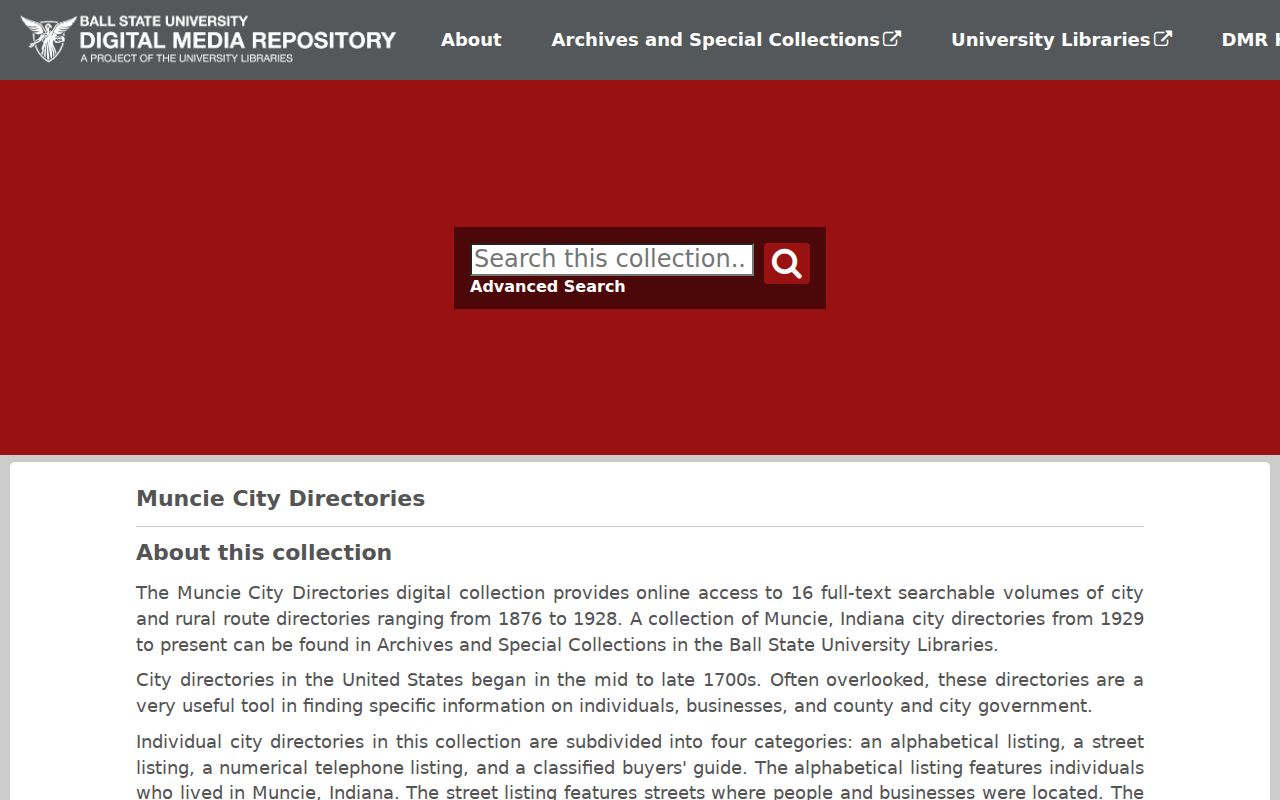
The collection screen is the starting point; the scanned page and its printed key remain the evidence for any name or address.
Decode a Muncie Directory Entry
A city directory entry can contain a name, address, line of work, business link, or phone block. It may list only a head of household. Later editions may make address-first work easier through a street section. The 1925-26 scan shows classified headings, individual names, street addresses, offices, and advertisements on the same page, so section context is essential.
| Printed name | Copy initials, spelling, and any spouse or widow notation exactly. |
|---|---|
| Street line | Record the house number and every abbreviation, such as Av, St, or R.R. |
| Trade or firm | Use the classified section to distinguish a person from an advertisement or office listing. |
| Phone or office block | Treat it as evidence for that publication date, not a current contact. |
| Edition and page | Keep both so another researcher can inspect the same scan. |
- Criss-cross section
- A part arranged by street and house number rather than by surname.
- Householder index
- An address-based list of the named household representative used by some directories.
- Abbreviation key
- The publisher's legend for shortened streets, roles, firms, and household terms.
Optical character recognition, or OCR, is searchable machine-read text. It can confuse initials, names, and addresses. Search variants, then read the page image.
Muncie Directory Research Desks
The Carnegie Local History and Genealogy collection joins directories with deeds, court and probate files, cemetery indexes, funeral records, newspapers, maps, yearbooks, and family files. Carnegie Library is at 301 E Jackson Street and is listed as open Tuesday through Friday, 10 a.m. to 5 p.m., with staff help at 765-747-8208.
See the Carnegie Library information page before viewing the captured page.
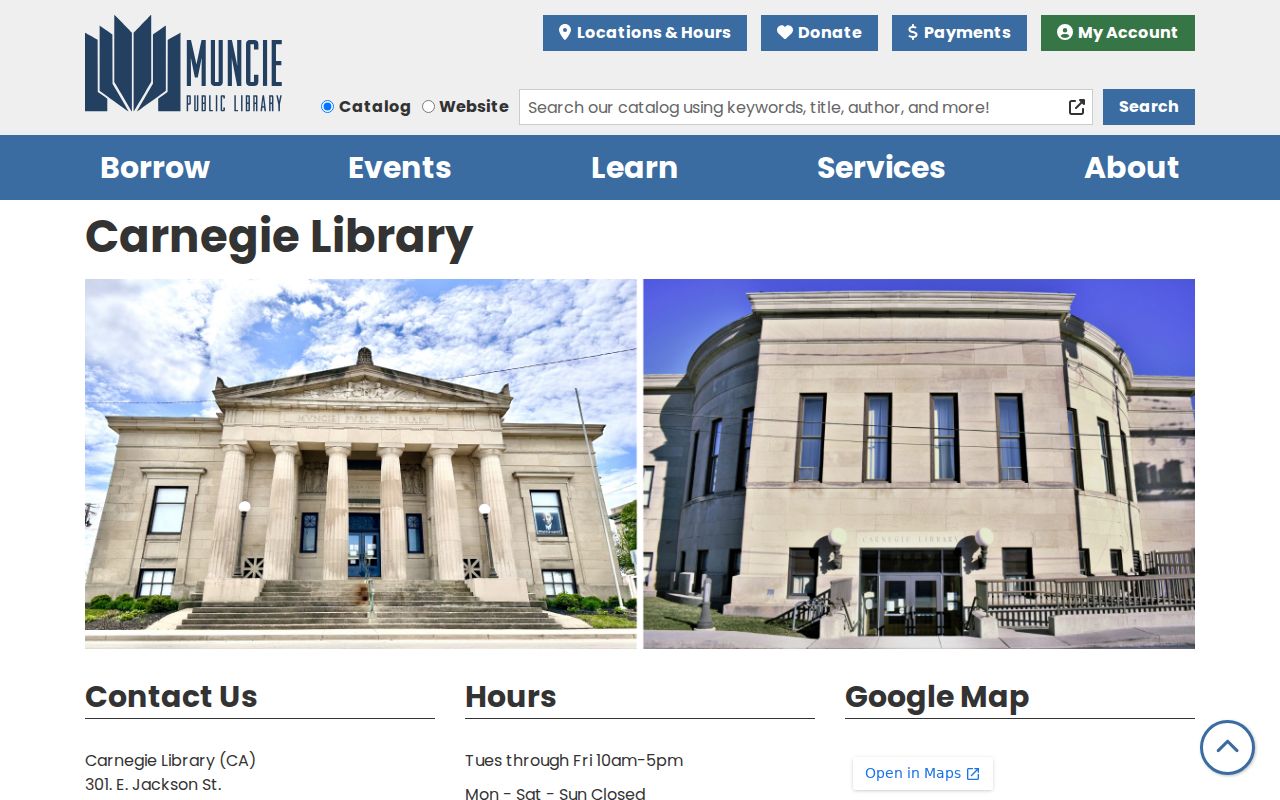
The building is the practical local stop for microfilm, fiche, and staff-assisted Delaware County research.
The Delaware County Historical Society Resource Center, at 120 E Washington Street, holds several hundred local-history and genealogy books plus thousands of articles, files, and photographs. Visits are by appointment. It is a good fallback for a family, organization, or building that appears in print but has little searchable text.
Review the Resource Center overview with the archive image below.
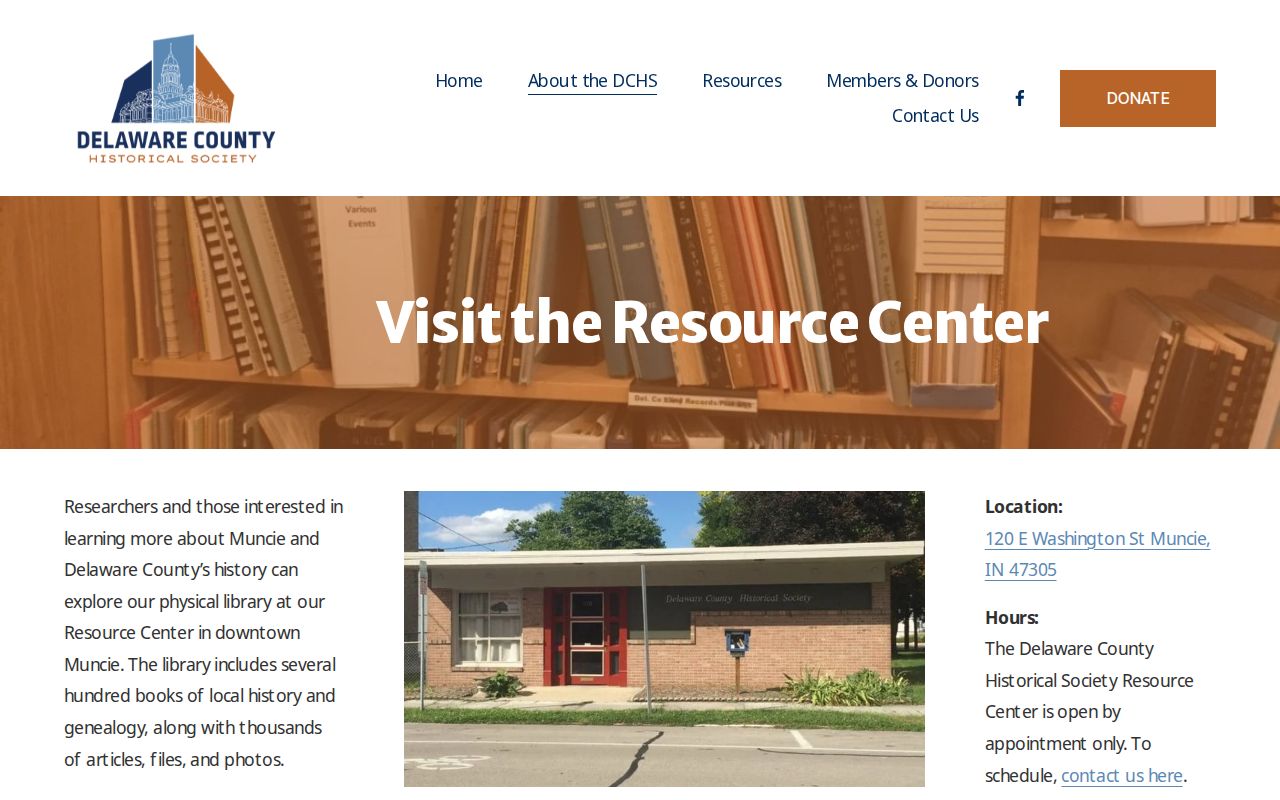
The historical society adds photographs and file context that a directory line alone cannot supply.
State Guide to Muncie Directories
The Indiana State Library city directories guide helps identify holdings beyond Muncie. Its separate 1890s list gives the Muncie 1895-96 call number. Use the state catalog when the local digital run skips the target year, and ask Ball State Archives about post-1928 physical volumes.
Consult the Indiana city directories guide shown in this capture.
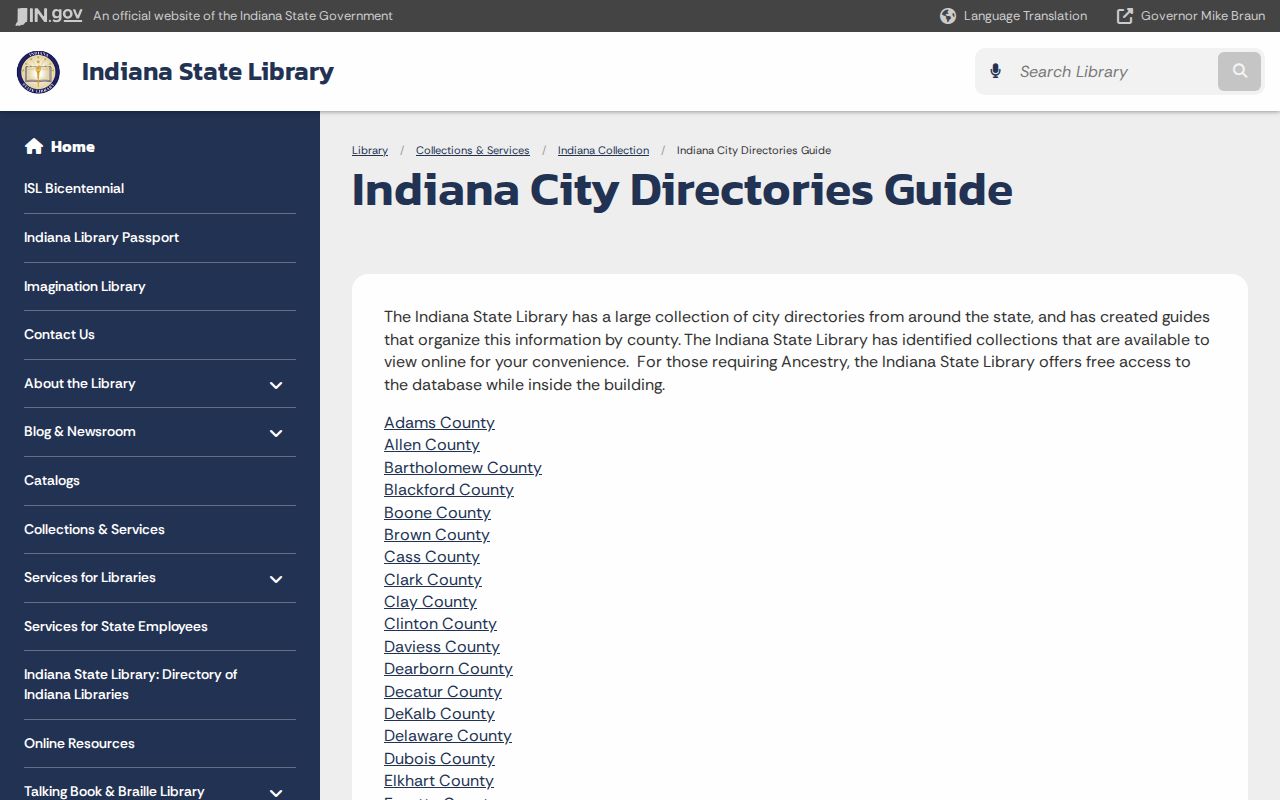
The statewide guide is a catalog aid, not proof that every listed book is online or available without a request.
When no image is online, provide the city, edition year, publisher if known, surname or street, and the type of page sought. That narrow request gives staff a useful target.
Muncie OCR Can Mislead
The Ball State scan is the source; OCR is just a way to find likely pages. The 1925-26 sample places names under headings such as photographers and physicians, alongside business advertisements. A text hit may therefore identify a firm, an ad, an office, or a resident entry. Read the heading before assigning a home address.
Try the surname with and without initials, then search the street name and a known firm. Compare the exact scan, the alphabetical section, and the street section. This method also catches an OCR error that turns a letter into a digit.
Note: Preserve the printed spelling in a citation, then record a modern spelling as a separate research note.
Trace Families in Muncie Directories
City directories fill the long gaps between federal census dates. They can show a move, a new trade, a spouse or widow notation, or a shift from a resident line to a business listing. Work edition by edition and resist merging two people on surname alone.
- Start with a known Muncie name, address, and approximate year. Search both the alphabetical and street sections.
- Copy the exact entry, edition, page, abbreviation key, occupation, and nearby household names.
- Move to the next available edition. Record each change instead of assuming a missing name means death or departure.
- Compare the nearest released census. Use age, spouse, occupation, and household members to resolve same-name people.
- Check deeds, newspapers, probate, cemetery, and obituary sources when the directory trail ends.
The 1890 federal census loss makes the 1881, 1893, and 1899 Muncie volumes especially useful. The directories help bridge 1880 to 1900, while deeds and newspapers test whether the household stayed at the same place.
Muncie Records Beyond Directories
Muncie Public Library's obituary card and related index runs cover material from 1837 through 2001, with later digital work and newspaper sources. Funeral-home files from Meeks, Parson, and Faulkner may supply family, cemetery, and death clues. WPA birth, death, and marriage indexes cover Delaware County from 1882 through 1920, but they are finding aids rather than certificates.
Ball State's Sanborn collection has about 200 Muncie maps from 1883 through 1911. A directory can name an occupant; a Sanborn sheet can show the building's footprint and use. Deeds then address ownership, which is not the same as occupancy. For current address-keyed sources, use the Muncie street directory workflow rather than stretching an old book into present-day proof.
Muncie Directory Timeline
The growth of the collection follows Muncie's own record-keeping network. Delaware County was created in 1827, long before the first verified digitized directory. The local library was organized in 1874 and opened in 1875. Emerson's first scanned edition followed in 1876-77. Carnegie Library opened in 1904, giving local print and family records a lasting public home.
| Year | Muncie directory milestone |
|---|---|
| 1876-77 | First verified digitized Emerson volume |
| 1907-08 | Verified Delaware County rural-route edition |
| 1915-16 | Williams Directory Company begins its dominant verified run |
| 1925-26 | Street browsing supports stronger address-first research |
| 1927-28 | Last edition in the sixteen-volume digital set |
| 1929 onward | Later physical holdings are noted at Ball State Archives |
The timeline also explains two common gaps. Most of the 1890 federal census was destroyed by fire, which makes the nearby Muncie editions far more useful. After 1928, the question changes from online searching to confirming a physical volume and arranging access. Neither gap proves that local records were destroyed.
Carnegie's local-history and genealogy center began in 2003 and moved into the Carnegie building in 2009. Muncie Public Library launched its Digital Archives in 2024. Those newer access points sit beside the older books rather than replacing them, so a thorough search may move from a web scan to microfilm, a catalog request, and then a staff-assisted file search.
Limits of Muncie City Directories
A directory reflects the publisher's collection method and print date. It can omit unlisted phones, boarders, children, short-term occupants, and people beyond the canvassed area. A rural route, postal label, township, and incorporated Muncie address are not interchangeable. Later physical holdings also need catalog confirmation before citing a year.
Use a city directory to establish historical presence, then test the conclusion against a census, deed, obituary, or custodian record. Libraries and archives offer discovery and context. Certified copies still come from the government office that keeps the original record.
Research tip. Treat each Muncie city directory entry as a dated clue, and require a second source before merging same-name people.