
How to Find Muncie Residents
Choose the first record by the fact already known. A street address belongs in the county parcel search. A full name and birth date can be tested in the Indiana voter-registration check. A name tied to a lawsuit, estate, or other public court event belongs in MyCase. Older names and addresses are best handled by city-directory, obituary, newspaper, deed, and census collections maintained by local libraries and archives.
- Write the exact name or address, spelling variants, middle initials, prior street numbers, and an approximate year.
- Search the record built around that fact: Beacon for an address, IndianaVoters for a complete identity match, or MyCase for a public court party.
- Read the result label closely. Separate an owner, mailing contact, registered voter, court party, and historical occupant.
- Confirm the person with a second source that supplies a matching date, address, relative, occupation, or document number.
- Ask the custodian for the public record when the web index stops at a citation or misses an older file.
The process works because records overlap without meaning the same thing. Keep a source log with the search date and exact role shown. That small step prevents a likely name match from becoming an unsupported claim.
Muncie Resident Records Offices
Muncie is the Delaware County seat, so the county courthouse system holds many records that identify owners, court parties, voters, and past households. City offices separately keep municipal records such as permits and council material. State agencies control statewide court access, professional licenses, business filings, and vital-record rules.
Assessor and GIS
Delaware County Beacon connects owner names, property locations, mailing addresses, parcels, legal descriptions, assessments, and deed references.
County Recorder
The Delaware County Recorder, 100 W Main Street, keeps recorded land instruments. Call 765-747-7804 about older books, images, and certified copies.
County Clerk
The Clerk at 3100 S Tillotson Avenue keeps trial-court, probate, marriage, judgment, and historical court files. The main number is 765-747-7726.
Local History
Muncie Public Library Local History and Genealogy supports directory, obituary, newspaper, deed, cemetery, and family research.
Ask the office that owns the record to correct it. A library can help find an old deed, but only the Recorder controls its official copy. The Assessor handles parcel fields, while the Clerk controls public court and marriage copies.
Current Muncie Directory Sources
No public office publishes one complete list of everyone who lives in Muncie. Instead, official systems identify a person in a defined role. The most useful directory sources differ in access and proof.
| Source | Useful starting fact | What it can establish | Main limit |
|---|---|---|---|
| Beacon parcel roll | Owner, address, or parcel | Recorded ownership and parcel facts | Owner does not mean occupant |
| IndianaVoters | Name, birth date, county | Registration identity match | Not a street-wide roll |
| Indiana MyCase | Name, case, or attorney | Public case role and docket | Some records are excluded or offline |
| Recorder index | Name or land instrument | Recorded deed and transfer trail | Remote index begins around 1982 |
| Library collections | Name, address, or year | Historical residence and family context | Publication-era evidence only |
Official rolls usually cost nothing to search, though copies, certified records, subscription land systems, and staff research can carry charges. Commercial people-finder compilations may merge stale or unrelated data. Use them, if at all, only as unverified leads and return to the public custodian for proof.
Find Muncie Parcels First
An address search should begin with Beacon. Delaware County describes the service as a free source for owner, property and owner addresses, parcel number, deed record and page, legal description, assessment, building sketch, and tax information. The county GIS viewer adds parcel and cadastral map context, but it warns that the map is not a legal survey.
| Search key | How to use it |
|---|---|
| Owner name | Try exact spelling, then a shorter surname or known co-owner. |
| Property address | Use the physical street location and test normalized forms. |
| Parcel number | Use the county identifier to separate similar addresses. |
| Legal description | Compare the lot, addition, tract, or section reference with the deed. |
| Deed record/page | Carry the citation into the Recorder's land index. |
Read address fields before attaching a person to a home. A county tax-sale sample places a Muncie property location at 1200 E Washington while showing a Chicago mailing address for the owner. Mailing and residence cannot be treated as synonyms. The Muncie street directory develops the address chain street by street.
Open the official Beacon property portal to see the county search surface pictured here.
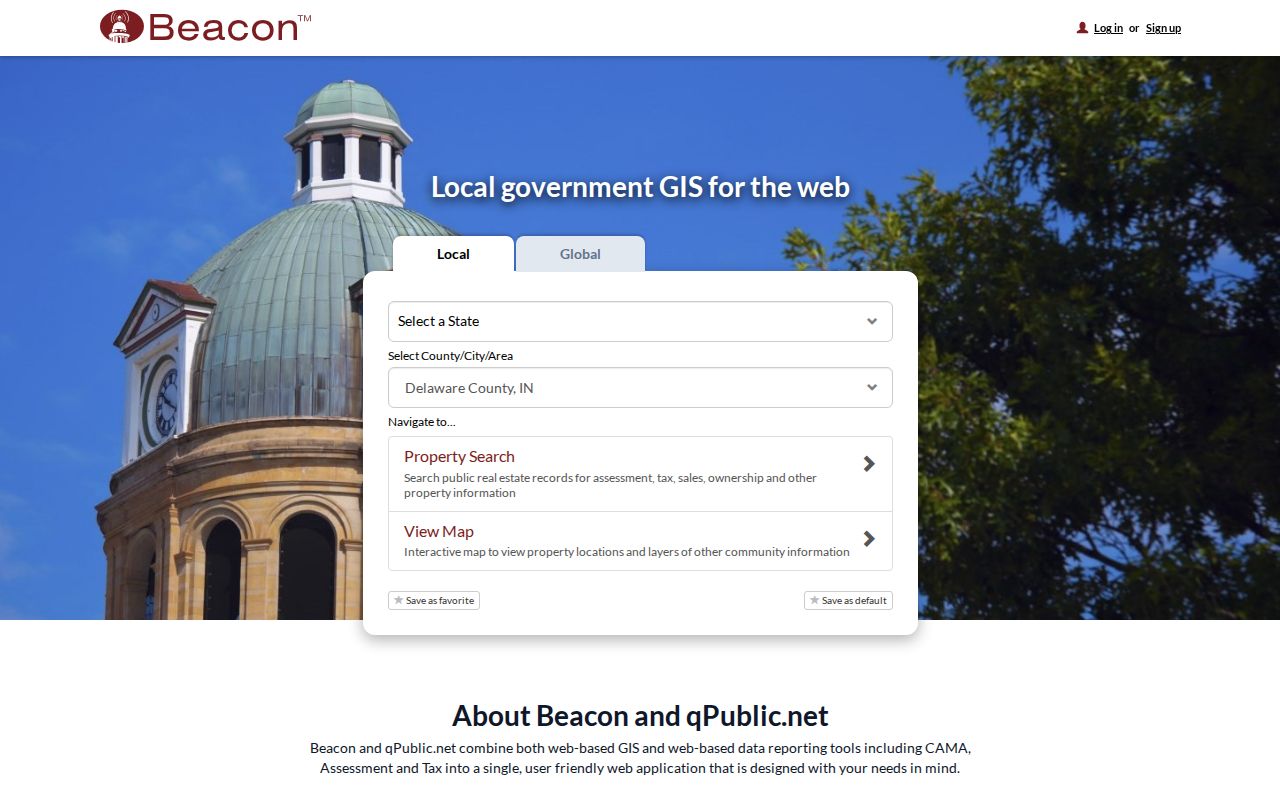
The portal is a parcel and ownership tool, not a live household roster. Date the result and follow its deed citation when ownership history matters.
Check a Muncie Voter Match
IndianaVoters requires four fields: first name, last name, date of birth, and county of current registration. Choose Delaware County. The state advises using the spelling on the registration, omitting a suffix, and avoiding initials that may cause a failed match. A no-match response says the voter was not found.
This is a controlled identity check, not a public browser for every voter on a block. Indiana election law regulates fuller voter files and protects certain fields. If a person expects a match but gets none, the right follow-up is Delaware County Voter Registration, not repeated guesses at private data.
Use the official Indiana registration portal shown in the captured view.
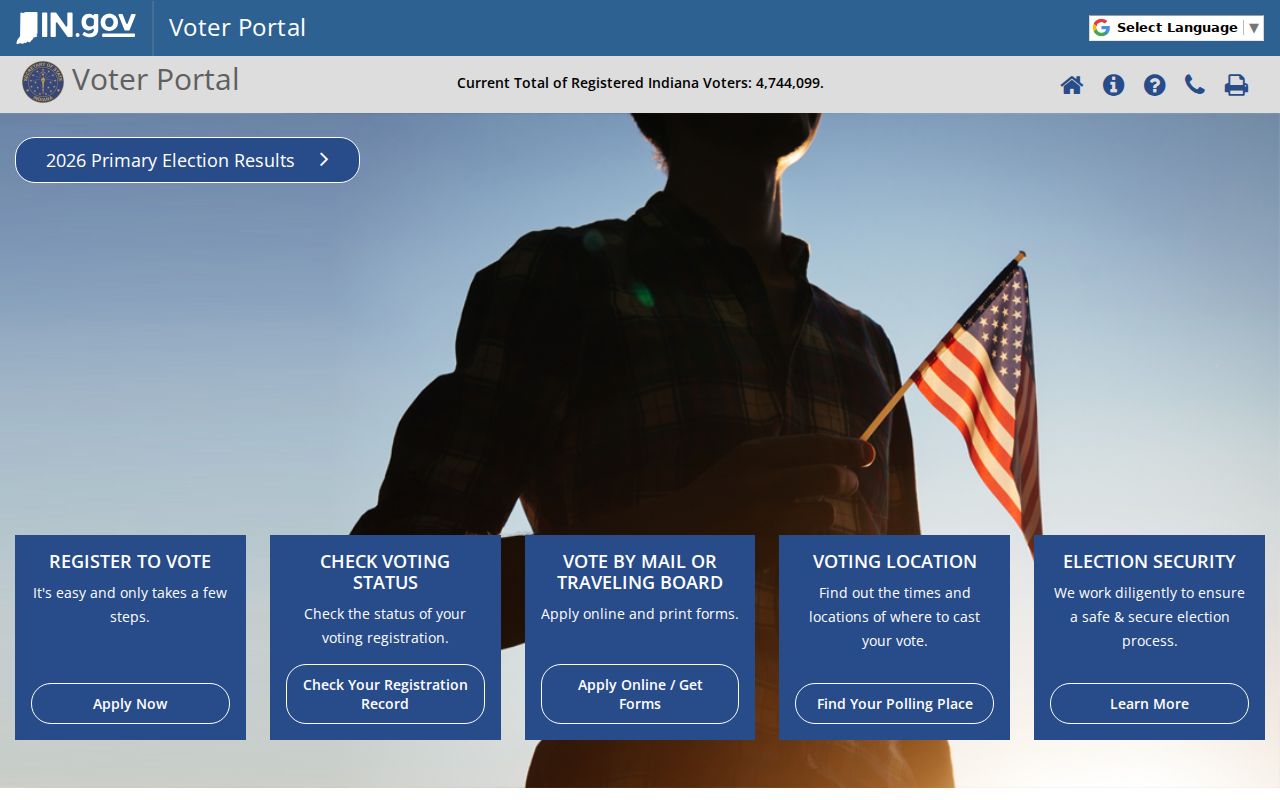
The four-field form confirms a registration combination. It does not prove present occupancy at a street address or supply a neighborhood roll.
Follow Muncie Public Court Records
Indiana MyCase offers Case, Name, and Attorney searches. A name query can use last, first, and middle names, an optional date of birth, sounds-like matching, court, case type, status, and filing-date filters. Results may show the court, case number, case type, filed date, parties, status, and public docket events.
Read the party role. A docket can identify a petitioner, respondent, creditor, lawyer, or another participant, but it does not prove a current home. Older, sealed, expunged, confidential, or non-Odyssey material may not appear. The Delaware County Clerk is the fallback for public historical files, a missing image, or a certified copy.
Review the Indiana MyCase search in the image below before choosing filters.
The court portal is best used to verify a known public event. For a one-name workflow, continue to the Muncie resident lookup.
Muncie Deeds Cross the 1982 Line
The Delaware County Recorder states that remote index and image coverage begins around 1982. Fidlar Tapestry supports occasional paid searching, while Laredo is a subscription service. Start with the owner or deed citation from Beacon, then use grantor and grantee searches to trace the recorded transfer.
Older Muncie deeds require a different route. Muncie Public Library provides digitized county deed material from 1827 through 1961. The 1962-1981 bridge was not confirmed in official online sources, so ask the Recorder or library about books, microfilm, or an office search. This is an access gap, not proof that deeds were destroyed.
- Grantor
- The person or entity transferring an interest.
- Grantee
- The person or entity receiving the recorded interest.
- Parcel
- A county-defined unit of land with its own identifier.
- Index
- A finding tool that points to a document; it is not always the document image.
- Criss-cross directory
- A directory arranged by street or phone number rather than only by surname.
Note: A deed proves a recorded interest and transfer date, not who slept at the property on that date.
Browse Historical Muncie Residents
Ball State's Digital Media Repository holds 16 digitized Muncie city-directory volumes from 1876 through 1928, including rural-route editions. Later directories from 1929 forward are noted in Ball State Archives and Special Collections, though the exact complete run and last printed year were not verified. An entry can give a spouse or widow notation, occupation, employer, street address, business listing, or phone detail.
Search OCR first, then inspect the scan. Old print, initials, street abbreviations, classified ads, and page damage can distort a text match. Record the edition year, page, section, printed name, address, occupation, and abbreviations. Compare the next edition rather than assuming one line describes a long period.
The Muncie city directory collections explain the full shelf, rural-route books, census pairing, and scan-reading method. The 1890 census loss makes editions near 1881, 1889, 1893, and 1899 especially useful for bridging households between the 1880 and 1900 federal censuses.
Muncie Library Research Routes
Muncie Public Library's Carnegie Library concentrates local history and genealogy material. Its collections include city directories, obituary cards and indexes, newspapers and microfilm, family files, WPA birth-death-marriage indexes, cemetery and funeral-home resources, and older deeds. Ball State adds digitized directories, Sanborn maps, yearbooks, photographs, oral histories, and university archives. The Delaware County Historical Society Resource Center holds local books, photographs, clippings, and files by appointment.
The library's research request form is the practical fallback for a specific Delaware County question. Research is listed at $15 per hour, prorated with a $4 minimum, plus copies and postage, with a typical response in one to five business days. Give staff a narrow name, date range, address, and record type.
Visit the Muncie local-history collection represented below.
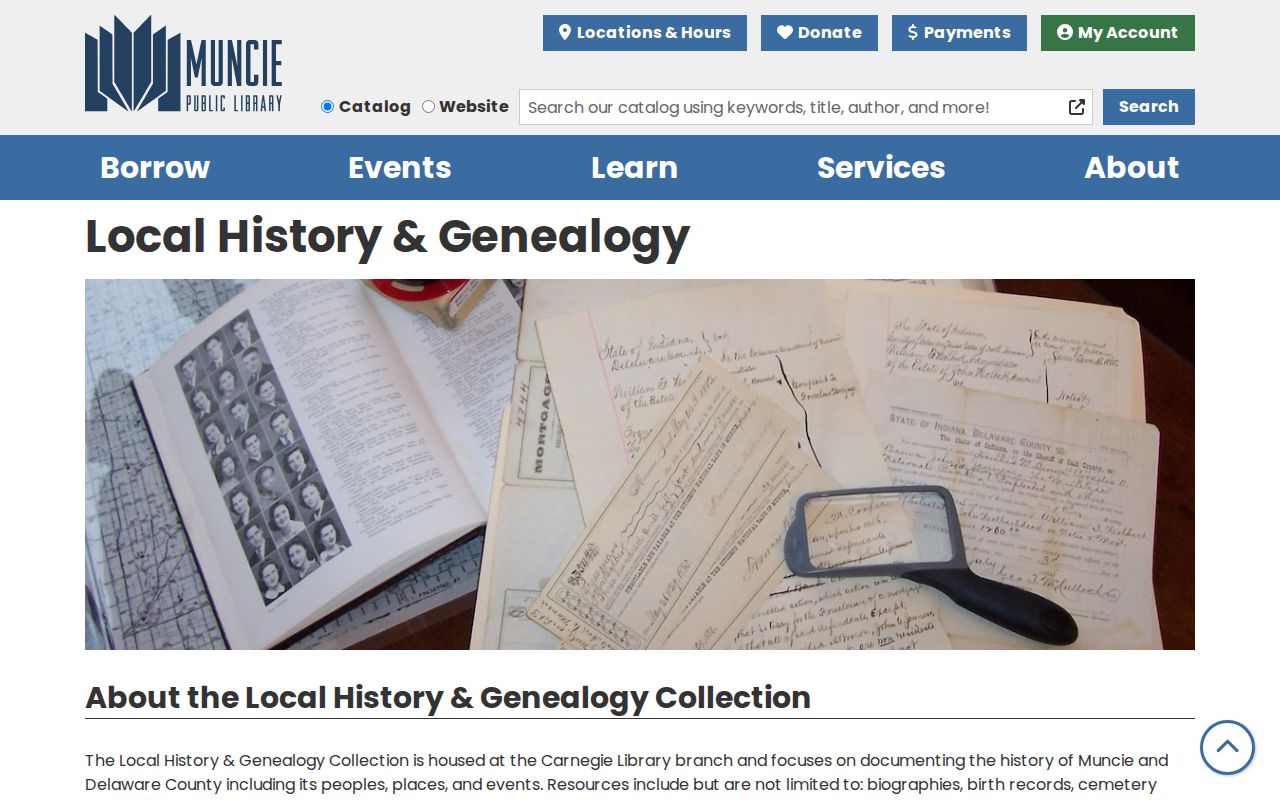
Library and archive findings supply context and discovery. Certified current records still come from the government office that keeps them.
Trace Past Muncie Residents
A backward address search joins records by time. Begin with the current parcel and deed citation. Follow each grantee to the prior grantor, then compare names with a directory edition, census, obituary, probate file, or newspaper from the same period. Sanborn fire-insurance maps can show the building footprint, street number, construction material, use, and additions for parts of Muncie from 1883 through 1911.
Address history has a local complication. Muncie's Uniform House Numbering System followed a December 26, 1974 ordinance after nearly 60 percent of buildings were reported as wrongly posted. Implementation continued from 1975 through 1989. Ball State's SC16 collection can bridge an old and new number by street, owner, or neighborhood context.
The past residents directory owns the full deed-and-address workflow. Treat a renumbering match as a bridge that must be checked against a parcel, legal description, map, or deed rather than as proof based on similar street text.
Define the Muncie Search Area
“Muncie” can describe an incorporated city, a postal label, a neighborhood, a parcel location, or the Delaware County seat. Those boundaries do not automatically match. Delaware County has 11 townships and several incorporated places, so a Muncie mailing address should not be assumed to prove city jurisdiction.
ZIP labels also differ from legal boundaries. USPS routing groups local ZIPs, while 47306 is tied to Ball State's campus address. Neighborhood names such as Downtown, Whitely, Riverside/Normal City, East Central, Industry, and University Heights are useful social and planning terms, not substitutes for parcel or precinct lines.
Check the Muncie ZIP directory when postal geography is the main question, or find Muncie neighbors when the goal is the immediate block. For ownership and legal boundaries, rely on the parcel record and a survey where needed.
Verify Muncie Names by Affiliation
A public affiliation can separate two people with the same name. The Indiana Secretary of State Business Search accepts entity name, business ID, filing number, registered agent, governing person, address, city, ZIP, type, and status. The Indiana Professional Licensing Agency verification searches names, professions, license types, status, county, ZIP, and license numbers.
Label the relationship precisely. A registered agent may be a service company. A professional address may be an office or mailing point. An unclaimed-property result may reflect an old reporting address. None automatically proves where a person now lives.
Probate, obituary, marriage, and cemetery records are stronger when family relationships matter. Birth certificates and adoption files follow strict access rules, so birth-parent searches must use Indiana's official registry, confidential-intermediary, or legal process instead of an open resident directory.
Request Missing Muncie Records
Indiana's Access to Public Records Act, IC 5-14-3, supplies the general request framework. Agencies generally acknowledge oral or hand-delivered requests within 24 business hours and requests sent by mail, fax, or email within seven calendar days. Production is due within a reasonable time, not one fixed number of days. Court, vital, voter, adoption, and other special record laws still control their own files.
Name the custodian, record series, person or parcel, date range, and desired format. Ask the Recorder for an instrument or deed image, the Clerk for a public case or marriage copy, the Assessor for a parcel field, and the local or state health office for an eligible vital record. A narrow request is easier to search and price.
County Clerk copy information lists $1 per page plus $3 per document for certification. Older Recorder price examples are dated and should not be treated as current. Ask for an estimate before ordering a large set.
Compare Muncie Directory Evidence
A residents directory result is reliable only within the role and date printed on it. Official sources have narrow purposes, while commercial compilations can combine names, phones, addresses, and relatives without showing a clear update date.
| Choice | Strength | Weakness | Best practice |
|---|---|---|---|
| Official roll or index | Named custodian and defined record | Limited to one public role | Read dates and field labels |
| Certified copy | Authenticated by the keeper | May require a fee or eligibility | Order only the needed document |
| Library or archive | Strong historical depth and context | May require staff help or scan review | Cite edition, page, and collection |
| Commercial compilation | Fast broad lead | Source, date, and identity may be unclear | Verify independently with custodians |
A clear note such as “parcel owner as of the search date” is more useful than a broad claim that someone “lives there.” Preserve uncertainty until separate records agree.
Respect Muncie Resident Privacy
Public access has firm limits. Juvenile, adoption, sealed or expunged, victim, mental-health, Social Security number, and other protected material may be withheld or redacted. Indiana's Address Confidentiality Program, often called Safe at Home, lets qualifying victims use a substitute mailing address and protects voter information from ordinary disclosure.
The Indiana Consumer Data Protection Act took effect January 1, 2026. Its private-data rules do not erase public records, and state or local government entities are excluded from that act. The relevant custodian and record-specific law still control access. Do not infer hidden facts from a blank portal result.
Lawful personal use. Use Muncie resident records for legitimate research. Never use a name, phone number, or address to stalk, harass, intimidate, impersonate, or harm anyone.
A respectful search stops where a record is confidential. Correct errors through the office responsible for the source, and avoid republishing sensitive personal details that serve no lawful research purpose.