
Muncie Address Sources by Era
The trail for past residents changes with the date. Beacon is a present-day starting point, while the Recorder’s stated remote range begins much later than the county’s first deed books. Ball State and Muncie Public Library supply annual or periodic household clues. Federal census schedules add full households at ten-year intervals through the latest public release. Sanborn maps show buildings and uses rather than naming every occupant.
| Source | Years covered | Where held | Evidence found |
|---|---|---|---|
| Recorder remote index and images | Index 1982-present; images about 1982-present | Delaware County Recorder, Laredo, Tapestry | Owners, transfer parties, instruments, legal descriptions |
| Digitized deeds | 1827-1961 | Muncie Public Library Digital Resource Library | Earlier title transfers and deed text |
| Digitized city directories | 16 volumes, 1876-1928 | Ball State Digital Media Repository | Residents, addresses, work, firms, rural routes |
| Federal census | Public schedules through 1950 | NARA and library databases | People grouped in households |
| Sanborn maps | Muncie collection, 1883-1911 | Ball State and Library of Congress | Building footprint, use, materials, street context |
| Obituary cards | 1837-2001 | Muncie Public Library | Death notice leads and family connections |
The period from 1962 through 1981 is the clearest access gap in the researched online chain. It may require Recorder books, microfilm, Auditor transfer records, or an office request. Do not fill that span by guessing from the owners on either side.
Start Muncie Previous Residents Today
Enter the modern address in Delaware County Beacon. Record the parcel number exactly, along with the situs address, owner, tax mailing line, deed record or page, and legal description. Situs means the physical location. The mailing line is where tax notices go. One official county sample pairs a Muncie situs with a Chicago mailing address, which shows why the two must not be merged.
The parcel and legal description are the bridge to earlier records. A street name can be shortened, misspelled, renamed, or renumbered. The legal description may identify a lot, subdivision, dimensions, or section-township-range location. Those details make it possible to reject a same-name deed that belongs to another tract.
Note: A current owner is the first title clue, not proof that the owner or every named party lives at the address.
Reverse Delaware County Deeds
The deed chain moves backward through buyers and sellers. In a recorded deed, the grantor transfers an interest and the grantee receives it. Start with the current owner as a grantee, identify the deed by its parcel or legal description, then turn the seller into the next grantee search. Repeat that cycle until the remote index ends or the property description changes.
- Copy the current owner, parcel, legal description, and deed reference from Beacon.
- Use the Tapestry occasional-search service or subscribed Laredo access to find the acquisition deed.
- Read the instrument date, grantor, grantee, document number, type, and legal description. Follow linked instruments only when they match the same tract.
- Search the grantor as a prior grantee. Work backward, keeping a dated log of every confirmed transfer.
- At the 1982 cutoff, move to office indexes, books, microfilm, or the library’s digitized deed material.
- Grantor and grantee
- The transferring party and receiving party named in an instrument.
- Chain of title
- The linked sequence of recorded interests in one property.
- Legal description
- The land description used for title, which can outlast a street number.
- Instrument
- A recorded legal document, such as a deed, mortgage, release, or assignment.
The Recorder office is at 100 W Main Street and can be reached at 765-747-7804. Remote pricing may change, so use the live service or ask the office rather than relying on an old county fee sheet.
Muncie Deeds Cross Three Eras
Delaware County began in 1827. State Library finding aids list early deed books from 1828, and grantor-grantee indexes begin in 1829. Muncie Public Library’s local material reaches from 1827 through 1961. The Recorder’s online statement resumes at 1982. The missing middle is an access problem, not evidence that transfers stopped or records were destroyed.
This is an insider advantage for previous-resident research. A portal-only search would overlook much of Muncie’s property history. Ask the Recorder about physical indexes and copies, check the State Library’s Delaware County microfilm finding aid, and use the library’s deed collection. The exact 1962-1981 bridge was not verified online, so cite the book, reel, office response, or scan actually consulted.
Muncie House History Help
The Muncie Public Library House History guide, updated December 16, 2024, connects Beacon, Auditor transfer records, the library’s 1827-1961 deeds, Sanborn maps, Ball State architectural archives, city directories, and the local numbering collection. It is a practical source map for past residents because it distinguishes title evidence from clues about the people and structure.
The Carnegie Library local-history and genealogy center holds directories, newspapers, maps, obituary material, microfilm, and local files. When a researcher cannot visit, the library research request form accepts a focused question and supporting file. The documented service is priced at $15 per hour, prorated with a $4 minimum, and usually reports a one-to-five-business-day turnaround. Those terms should be checked when submitting.
Give staff one address, a date range, known names, and both old and current numbering if available. A narrow request is easier to answer than a request for every past resident without a time frame.
Place Muncie Residents on Sanborns
The Ball State Muncie Sanborn collection describes about 200 maps dating from 1883 through 1911. Fire-insurance sheets can show a building footprint, construction material, use, additions, and nearby street context. They do not by themselves prove who occupied a building. Pair the sheet with a directory entry, deed, or census schedule from the same period.
The successful Sanborn collection capture provides the image source assigned to this previous residents page.
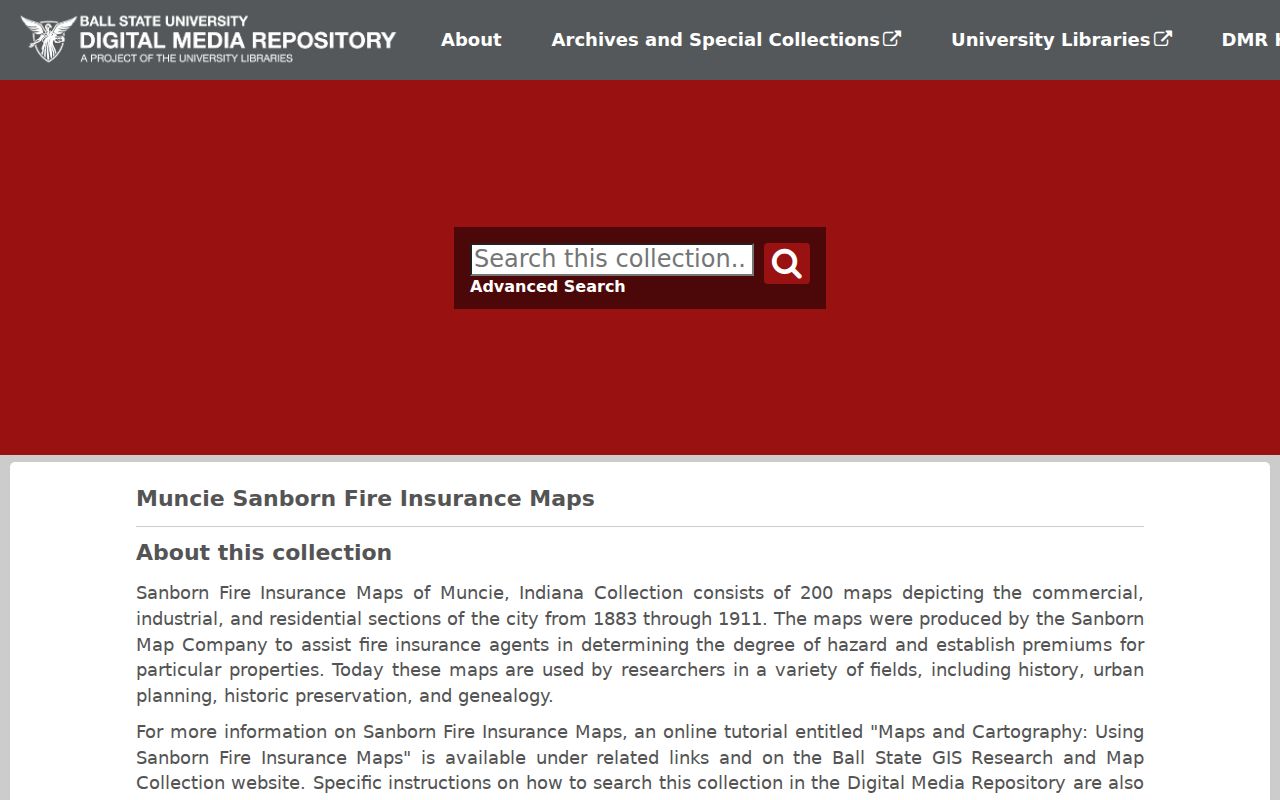
The map collection can explain why one address held a dwelling in one year and a shop, addition, or vacant lot in another. Always note the sheet date and compare street names carefully.
Bridge Muncie House Number Changes
On December 26, 1974, Muncie adopted a Uniform House Numbering System after duplicate street names and widespread posting errors created problems for emergency, postal, and delivery work. Nearly 60 percent of buildings were reported as incorrectly posted. Implementation lasted from 1975 through 1989. A family may therefore appear to move in a directory even when only the address label changed.
Muncie Public Library’s SC16 collection is the main local bridge. Search it by street, old number, new number, owner, and neighborhood context. No complete online old-to-new table was found. Confirm a conversion with the legal description, plat, parcel, Sanborn sheet, or a directory sequence. This documented event is more useful than forcing an old number into a current portal.
Match Muncie Past Households
Deeds identify title parties, but previous residents may include people who never owned the property. Ball State’s digitized Muncie directory run contains 16 volumes from 1876 through 1928, including rural-route editions. Entries may show a name, address, occupation or business context. OCR can be wrong, so read the scanned page and its abbreviation key. Later physical directories are noted in local holdings, but the last printed year was not verified.
- Choose the closest directory edition before and after a confirmed deed or known family date.
- Search the surname, then check street or householder sections when the volume provides them.
- Pair the directory with the nearest public census year. The latest public federal schedule is 1950 because of the 72-year rule.
- Compare all household names, ages, work clues, and the address. Do not treat a directory omission as proof of absence.
- When 1890 is the target, bridge the census loss with 1880 and 1900 schedules, directories, deeds, Sanborn maps, and newspapers.
The collections themselves, including publishers and reading conventions, are detailed on the Muncie city directory collections page. For an address trail, each edition functions as a dated snapshot rather than a continuous resident roll.
Close Muncie Resident Trails
Muncie Public Library obituary cards span 1837-2001 and can lead to family names, death dates, funeral details, and cemetery clues. Newspaper holdings include the Muncie Daily Herald for 1892-1906 in a library database listing, ProQuest Muncie papers back to 1900, microfilm, and Hoosier State Chronicles. An obituary can explain where a former occupant went or identify relatives, but it should be checked against the original notice.
Probate files form another endpoint. Delaware County Clerk holds probate within the trial-court collection, while public Odyssey entries may appear in Indiana MyCase. Wills, inventories, heir addresses, and notices may require a Clerk file request. Older, confidential, sealed, or non-Odyssey material will not necessarily appear online. The Clerk is at the Delaware Justice Center, 3100 S Tillotson Avenue, and can be reached at 765-747-7726.
A strong past-resident conclusion states what each source proves. The deed proves a title event. The directory suggests occupancy in its publication year. The census records a household on its enumeration date. The obituary or probate file supplies a later family link.
Use Muncie History Lawfully
House history, family history, heir research, and neighborhood curiosity are legitimate reasons to consult public records. Even so, current people may have protected addresses, and archival sources can contain errors. Indiana’s Address Confidentiality Program shields qualifying participants through substitute address handling. Redactions and access limits must be respected.
Record the citation, date, and custodian for every finding about previous residents. Distinguish a historical occupant from a present person. If a record conflicts with another, seek the source image or ask the office that holds it instead of choosing the more convenient version.
Lawful use. Use Muncie address history for research and personal inquiry, never to track, intimidate, harass, or harm a living person.